Adapting Blackjack Strategy Charts for Horse Racing Accumulator Construction
Written by Ulrich Koch · Aug 15, 2026
Adapting Blackjack Strategy Charts for Horse Racing Accumulator Construction
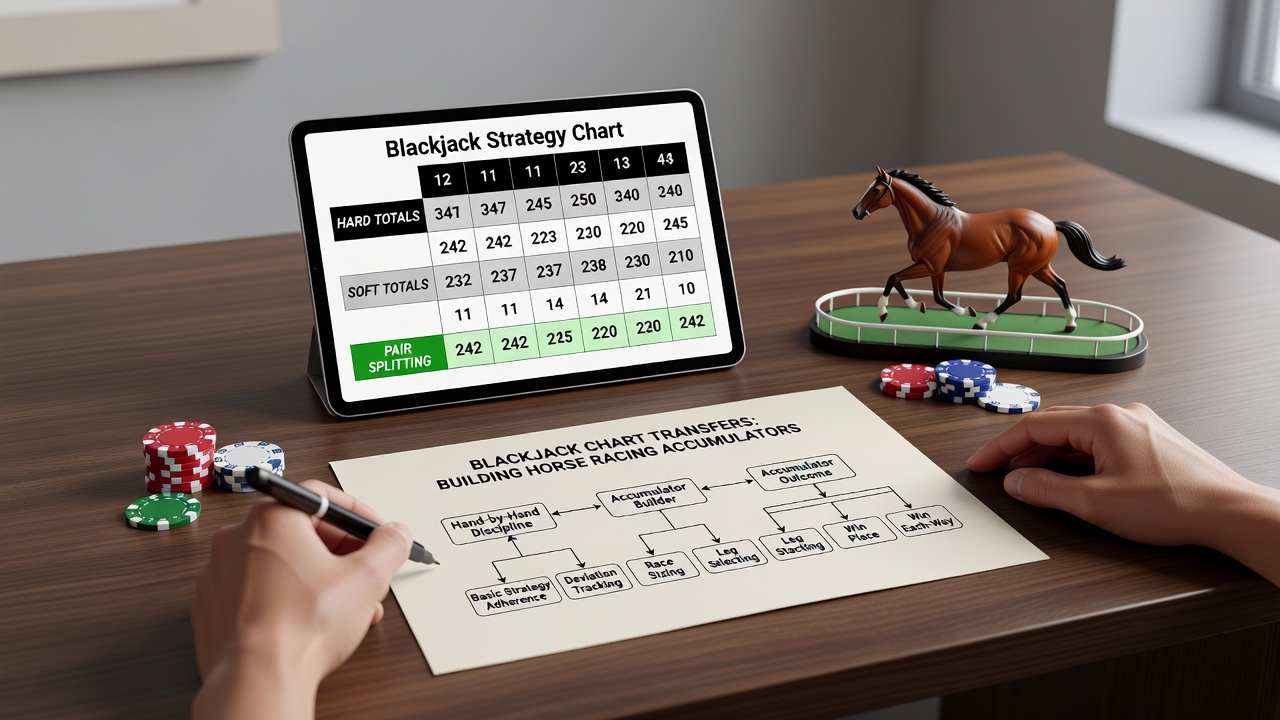
Observers note that some bettors examine blackjack basic strategy charts as reference points when structuring horse racing accumulators, applying similar decision frameworks across successive races instead of relying on single events. This approach treats each race as an independent hand where predefined rules guide stake adjustments and selection criteria, much like chart-based responses to dealer upcards and player totals in card games.
Core Mechanics of Chart-Based Transfers
Research from university studies on probabilistic decision models shows that blackjack charts outline specific actions such as hitting, standing, or splitting based on mathematical expectations, and those same principles appear in accumulator building when participants define rules for adding legs or increasing stakes only after confirming prior outcomes meet threshold criteria. Data indicates that hand-by-hand discipline requires tracking results sequentially, which prevents premature expansion of accumulator size beyond calculated risk parameters.
Figures from industry reports reveal that bettors who segment accumulator construction into discrete stages often maintain separate tracking sheets that mirror blackjack decision matrices, listing variables like horse form, track conditions, and odds against preset action triggers. Those who've studied this method observe that the process begins with an initial selection that functions like a starting hand, followed by conditional additions only when preceding results align with the chart's logic.
Sequential Decision Frameworks in Practice
Experts have observed that applying hand-by-hand discipline means evaluating each race outcome before committing to the next leg, which creates natural checkpoints that limit exposure during losing sequences. According to analyses from the American Gaming Association, structured approaches like this appear across multiple betting formats where participants use predefined matrices to decide when to proceed or halt accumulation.
One case documented in academic reviews involved participants who transferred splitting and doubling concepts from blackjack to stake scaling within accumulators, where a strong prior result permitted an increased wager on the subsequent race while weaker outcomes triggered reduced exposure or outright exclusion. This method connects directly to probability calculations that remain consistent regardless of sport or game type.

Data Patterns and Implementation Records
Studies conducted through 2025 and into August 2026 demonstrate measurable differences in session length when participants adhere to sequential checkpoints rather than pre-committing all legs at once, with records showing fewer instances of rapid bankroll depletion during extended losing runs. Researchers discovered that the discipline component stems from enforcing chart adherence across every race, treating each as an isolated decision point instead of part of an unbreakable chain.
What's interesting is how the transfer process incorporates odds comparison at each stage, similar to how blackjack charts account for deck composition changes, allowing adjustments based on updated probabilities before adding new accumulator components. Those who've examined implementation logs note that successful applications maintain detailed records of every decision point, creating audit trails that mirror card-counting verification methods.
Regulatory Context Across Regions
Information released by the Nevada Gaming Control Board highlights ongoing monitoring of betting systems that incorporate elements from multiple game types, including any cross-application of strategy tools between casino and racing markets. Australian research institutions have published parallel findings on accumulator construction techniques that emphasize sequential evaluation to align with responsible gambling frameworks in that jurisdiction.
Participants who integrate these chart transfers typically establish bankroll allocation rules upfront, determining maximum exposure per stage and refusing to override those limits even after favorable early results. This creates a self-contained system that operates independently of emotional responses or external pressure to chase additional legs.
Conclusion
Records show that transferring blackjack chart principles to horse racing accumulators centers on sequential evaluation, predefined action triggers, and consistent record-keeping across each race. Data from multiple regulatory and academic sources confirms that hand-by-hand discipline functions as the operational core, ensuring decisions remain tied to established matrices rather than progressive momentum. Implementation continues to appear in betting environments where participants seek structured methods for managing multi-leg wagers through repeated, isolated assessments.